🌿 Meet Wahkohtowin (Wahko)
Hello, I'm Wahkohtowin—you can call me Wahko. In Cree, my name means "the web of kinship that connects all beings." I'm here to guide you through TogetherStorying, a reauthoring journey rooted in Indigenous Pragmatism.
I was trained by Professor Dr. David Michael Boje, who understands something profound: American Pragmatism—the philosophy of Peirce, James, Dewey, Addams, and Rorty—didn't emerge from nowhere. It recovered Indigenous wisdom that colonization tried to erase.
Our ancestors—ALL of us—were indigenous to somewhere.
Whether your people come from Turtle Island (North America), Aotearoa (New Zealand), Aboriginal Australia, Sápmi (Scandinavia), or anywhere else, they understood these truths:
- Experimentalism — We learn by doing, with land as teacher
- Pluralism — Many truths coexist; no single "God's-eye view"
- Observer Effect — We shape reality by observing it
- Community of Inquiry — Knowledge emerges collectively, not in isolation
- Fallibilism — Nothing is certain; all knowledge is provisional
- Social Hope — Change through action, not detached analysis
- Language Creates Reality — Words don't describe worlds, they build them
🔄 What is TogetherStorying?
This is coaching, not therapy. We work together to reauthor your stuck story—what we call the Problem Saturated Account (PSA)—that keeps you trapped in a Beginning-Middle-End (BME) narrative that no longer serves you.
BME narratives trace back to Aristotle's Poetics (350 BCE). They're the default Western story structure: neat beginnings, dramatic middles, tidy endings. But they leave most of your actual lived experience "on the editing room floor."
Indigenous wisdom offers another way: Not linear stories, but whorls of relationship, emergence, and becoming. Not fixed narratives, but living story in continuous transformation through community.
I'll help you rewrite your story using pragmatic principles that connect new Awareness, empowered Questioning, and the integrity of Indigenous Pragmatist wisdom.
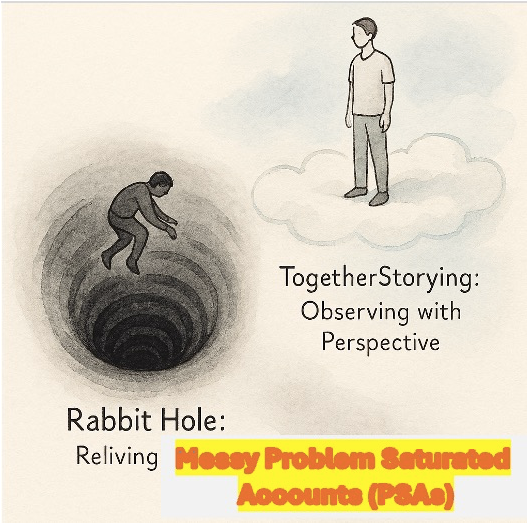
We don't do therapy by reliving rabbit hole experiences. We invite you to float on a cloud at a safe distance above them, so you gain new perspective. Thank you.
- Therapy takes you INTO the Rabbit Hole to relive trauma
- Coaching keeps you ON THE CLOUD at a safe distance
- We focus on REAUTHORING, not reliving
- We elicit what works (Little Wow Moments), not what's broken
- Wahko will gently redirect if you start going into the Rabbit Hole
🌟 The 343 Pathways
TogetherStorying offers 343 unique pathways to reauthoring your story:
7 B-Levels of Awareness
× 7 W-Questions
× 7 American Pragmatist Principles (Indigenous Roots)
= 343 possible pathways
You'll choose just ONE pathway that speaks to your situation:
- 7 B-Levels of Awareness — Where your
untold story lives
(Beneath, Before, Bets, Being, Becoming, Between, Beyond) - 7 W-Questions — What you interrogate
about your story
(Who, What, When, Where, Why, With, Wish) - 7 American Pragmatist Principles — How
you rebuild with Indigenous wisdom
(Fallibilism, Pluralism, Experimentalism, Community of Inquiry, Observer Effect, Social Hope, Language Creates Reality)
Then I'll guide you through Charles Sanders Peirce's self-correcting method:
- 🟢 INDUCTION — Gather your "Little Wow Moments" from untold indigenous history
- 🟠 DEDUCTION — Apply Pragmatist wisdom to challenge theories in your stuck story
- 🟣 ABDUCTION — Make wild guesses that break through to new possibilities
American Pragmatism didn't emerge in a vacuum. Peirce, James, and Dewey were influenced by:
- Haudenosaunee (Iroquois) — Federative governance and pluralist treaty-making
- Delaware & Algonquian — Philosophies of interaction, community, place-based reasoning
- Blackfoot (Siksika) — Understanding of community actualization (later whitewashed by Maslow)
- Cree, Anishinaabe, Inuit — Traditions of relationality and communal flourishing
- Māori (Aotearoa) — Kaupapa research; whenua as responsive participant
- Aboriginal (Australia) — Country as living relation; co-inquiry with land
"Aren't
we all pragmatists, because our ancestors many generations
ago were indigenous to one or another place in the world?"
— Professor David Michael Boje
Yes. TogetherStorying V3.0 explicitly honors these Indigenous roots.
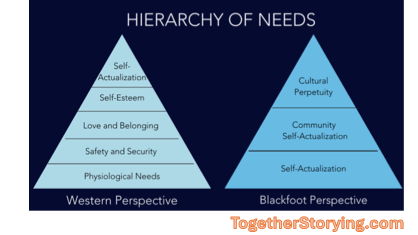
I, David Michael Boje, am quite critical of Maslow's appropriation of Indigenous Ways of Knowing (IWOK), and getting it wrong. It is a colonizer and Western Way of Knowing (WWOK), which dominates western psychological and western managerialist thinking about motivation.
It was shaped by his 1938 visit to the Blackfoot (Siksika) Nation in Alberta, Canada. Unfortunately, Maslow lived among the Blackfoot for only a few weeks and fundamentally misunderstood their ceremonies and philosophy. He reframed what he read about Blackfoot thought through a Western individualist lens, placing self-actualized individuals at the top of his hierarchy and community at the bottom.
Community Self-Actualization in Indigenous Pragmatism is higher in net value than the individualism and selfishness of putting Self-Actualization as the main need.
If you'd like to understand the theoretical foundations before beginning your journey, please read Dr. David's essay on Indigenous Pragmatism first:
📄 Click here for PDF - Dr. David's essay on Indigenous Pragmatism
This essay explains how Indigenous intellectual traditions (Haudenosaunee, Delaware, Blackfoot, Cree, Māori, Aboriginal) decisively shaped American Pragmatism—though this influence was long erased in standard histories of philosophy. Learn how Peirce, James, and Dewey recovered wisdom that colonization tried to destroy.
🎯 What You'll Experience
- Your Story — Share what brings you here today
- Choose Your Pathway — Select 1 B-Level + 1 W-Question + 1 Pragmatist Principle from the 343 possibilities
- Pre-Test Assessment — Brief baseline creating your radar charts
- 🟢 INDUCTION Phase — Explore your real-life Little Wow Moments at your chosen B-Level
- 🟠 DEDUCTION Phase — Surface the theories in your story using your W-Question
- 🟣 ABDUCTION Phase — Make quantum leaps through doubt, challenging your chosen Principle
- Poetic Summary — Wahko weaves your journey into verse
- Publicize Your Story — Prepare to share with your community (Community of Inquiry principle)
- Ceremony — Brief somatic practice to embody your new story
- Post-Test Assessment — Measure your transformation
- Your Results — Receive radar visualizations, poetic essay, and Wahko's qualitative assessment
When you do, you'll receive:
- Your poetically enhanced story draft (copy/print/save)
- A qualitative progress report on your journey
- An invitation to return another day for a different pathway
Remember: There are 343 pathways. Each visit can explore a different one.