Ready to Begin Healing?
Dr. Boje is available for community interventions — virtually via Zoom or in-person at your location.
One conversation could change everything.
Request Dr. Boje for Your Community → Welcome to TogetherStorying
Coaching Software and our Programs in Person
Read this PDF on Breathing Live Energy int Your Wheel of Life with Vujade, and 777
What People Are Saying
"This process helped me connect to the story before the story that, until now, has influenced me in limiting my full potential. The new story is full of possibilities."
— Edward Korbal"This is an efficient and effective way to engage in very deep introspection. In a single session, I was able to identify my flawed self-story and create a more empowering and confidence-boosting narrative that clarifies my goals and helps me process those negative intuitions."
— Sigi TrevizoChoose Your TogetherStorying Path
Our
Decision Tree Software
Choose
the version that fits your needs
🔄 Version 1.0
✨Decision Tree Software for Coach TrainingIncludes:
- 7 Restorying Process steps
- 7 Mindfulness Questions for Self-Awareness
- How to Set Coaching Agenda
- How to Stay out of the Rabbit Hole
- Coach to find joy, gratitude, peace, love & self-confidence
🎖️ Quick Start: 2-Minute Tutorial
Watch Quick Instructions🪢 Version 2.0
American Pragmatism Western Ways of Knowing (WWOK)
Ditch that stuck in the mud story, find your NEW STORY
Takes 10 minutes | Yes, It's FREE!
Pragmatic 7 x 7 x 7 inquiry conversation decision tree for reauthoring your living story
🦋 Version 3.0
Indigenous Pragmatism Focus
Update your story & see pre/post test results
Up and running | Yes, FREE to everyone!
Honors Indigenous intellectual traditions as foundational to American Pragmatism
🦋 Version 4.0
Bridging IWOK and WWOK Edition
Version 4.0 Allow
users to bridge Western Ways of Knowing (WWOK) and
Indigenous Ways of Knowing (IWOK) by selecting
specific metaphysical approaches (e.g.,
"Relationality" vs. "Substance") to prompt their
reauthoring their living
story into a
Choose intro version or advanced academic version Latest Video:
🎖️What's
your METAPHYSICS IWOK &/or WWOK? click for
video
🦋 Version 5.0
In Beta Testing, nor ready for use
Version 5.0 Allow Echo Chambers of Tamaraland
Version
5.0 is designed to address factorial complexity. For
example, in a scenario with 10 simultaneous "rooms"
or contexts, the number of permutations skyrockets
to 10! or 3,628,800 combinations.
• Total
System Capacity: The total number of
pathway configurations is calculated by summing the
distinct structural layers. Versions 1.0-4.0
represent practice configurations for the core
pathways, while the Version 5.0 example introduces a
separate combinatorial structure. Combining them
yields a total of 3,630,172 unique
pathway configurations.
Our TogetherStorying Programs
Support Our Mission
Make a Donation
Your tax-deductible donation provides free coaching to veteran and first responder families. Every dollar helps a family restore their shared story.
Donate NowFirst Friday Webinar
Check your time Zone
9AM Pacific | 10AM Mountain | 11AM Central | Noon
Eastern
Join our virtual Zoom sessions. Work with your family system while learning the TogetherStorying method. Accessible FREE from anywhere to anyone who wants to help.
More on Our Monthly WebinarRanch Coaching
Experience equine-assisted restorying at our Caballo, NM ranch. Work with rescued horses and our expert coaches for transformative family healing.
Visit RanchIsland Retreat
3-day immersive experience on Catalina Island, CA. Meditation, sand tray work, and intensive family restorying in a sanctuary setting.
Learn MoreCertification Program
Become a Coach
Train to become a Certified TogetherStorying Coach. 12-session program teaching our proven PERVIEW methodology. Build your coaching practice.
Get CertifiedAbout Us
Learn about our founders Dr. David Boje (Vietnam veteran) and Dr. Grace Ann Rosile, and 30 years of research behind the TogetherStorying method.
About Us🎥 Online Video Resources (Watch BEFORE Using Decision Tree Software)
These videos will help you get the most out of the TogetherStorying software. Start with the shorter ones if you're new!
- 🎖️ Rewrite that old story into something empowering & get unstuck (14 sec. short)
- 🎖️ Don't believe your bullshit opinions (14 sec. short)
- 🎖️ How to coach, Mr. military (14 sec. short)
- 🎖️ 2 min: How to REAUTHOR STORY with 7x7x7 using TogetherStorying online software (Quick instructions)
- 🎖️ 3 min: HOW TO REWRITE YOUR STORY (A bit more instructive)
- 🎖️ 10 min: How use the WRITE YOUR STORY with online software? (Has more ins and outs)
- 🎖️ 22-min INSTRUCTIONS on HOW TO REWRITE your Story at TogetherStorying with its online Reauthoring software (Complete Demo of step-by-step walkthrough)
- 🎖️ If you want an introduction to What is Pragmatism, who are the key figures? See How to think like a pragmatist (16 min)
- 🎖️ What's your METAPHYSICS IWOK &/or WWOK? 10min.
- 🎖️ Why Turn Maslow's Hierarchy Upside Down? 5-minute video explaining our Indigenous Pragmatism approach
Why TogetherStorying? The Deep Methodology
TogetherStorying is a revolutionary coaching methodology that transforms how we understand and reshape our life narratives. Unlike traditional storytelling that looks backward, TogetherStorying engages the quantum field of possibilities—the antenarrative realm where future stories are still forming.
The Power of Antenarrative
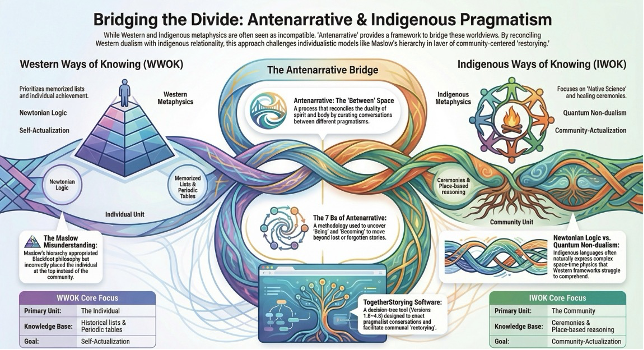
At the heart of TogetherStorying lies the concept of antenarrative—the living, unfolding stories that exist before they become fixed narratives. This is the quantum realm of possibility where your future is still being written.
Indigenous Intellectual Foundations
TogetherStorying V3.0 explicitly acknowledges and honors the Indigenous intellectual traditions that form the foundation of American Pragmatism and our coaching methodology.
Our methodology draws from:
- Seven Generations Thinking - Planning for long-term impact
- Relational Ontology - Understanding self through connection
- Cyclical Time Concepts - Moving beyond linear progression
- Sacred Reciprocity - Balanced exchange in all relationships
- Land-Based Wisdom - Grounding practice in place and ecology
Research-Backed Methodology
TogetherStorying is grounded in 30+ years of rigorous academic research led by Dr. David Boje, Professor Emeritus at New Mexico State University and globally recognized scholar in organizational storytelling.
Academic Foundation
- 35+ published books on storytelling and organizational change
- 150+ peer-reviewed articles in top journals
- Ranked globally among top social sciences scholars
- 2025 ODC Lifetime Achievement Award recipient
Key Research Areas
- Antenarrative theory and quantum storytelling
- Storytelling organizations and narrative change
- Indigenous intellectual traditions in American Pragmatism
- Trauma-informed narrative therapy for veterans
- Regenerative capitalism and organizational transformation
7 True Storytelling Principles (Version 2.0)
The True Storytelling Principles form the foundation of our Western Ways of Knowing (WWOK) approach in Version 2.0.
Seven True Storytelling Principles:
1. You yourself must be true and prepare the energy and effort for a sustainable future
Authenticity and commitment to long-term sustainability are foundational to effective storytelling.
2. True storytelling makes spaces that respect the stories already there
Honor and acknowledge existing narratives and the contexts in which they exist.
3. You must create stories with a clear plot, creating direction and helping people prioritize
Provide narrative structure that guides understanding and action.
4. You must have timing
Recognize the importance of when stories are told and how they unfold temporally.
5. You must be able to help stories on their way and be open to experiment
Facilitate narrative development while remaining flexible and adaptive.
6. You must consider staging, including scenography and artefacts
Pay attention to the physical and symbolic context in which stories are presented.
7. You must reflect on the stories and how they create value
Engage in ongoing evaluation of narrative impact and meaning-making.
7 Antenarrative Bs Framework
The Seven Bs provide a comprehensive map for quantum storytelling transformation, guiding you through seven dimensions of narrative change:
🌱 Beneath: Excavating Root Stories
Journey to the foundational narratives beneath your conscious awareness. Uncover family systems, cultural conditioning, and archetypal patterns that have been running your life on autopilot.
⏮️ Before: Understanding Historical Narratives
Examine the past not to dwell there, but to understand how it shapes your present. Identify patterns that no longer serve through strategic narrative archaeology.
🎲 Bets: Engaging Ante-narratives
This is where transformation happens. Learn to perceive and engage with the not-yet-formed stories, the possibilities still in motion. Shape your future before it crystallizes into fixed patterns.
🧘 Being: Presence and Embodiment
True transformation requires embodied presence. Through mindfulness practices and somatic awareness, learn to inhabit your life fully rather than being carried along by unconscious narratives.
🦋 Becoming: Future-Oriented Identity
Work with future-oriented narratives that pull you forward, creating coherence between who you are and who you're called to become. This includes vision work, purpose clarification, and identity evolution.
🤝 Between: Relational Narrative Practice
No story exists in isolation. Learn how your narratives interact with others in relationships, teams, organizations, and communities. Navigate narrative conflict and co-create shared stories.
✨ Beyond: Transcendent Meaning
Connect to something larger than yourself. How do your personal narratives participate in collective transformation? This includes spiritual practice, legacy work, and contribution to the greater good.
Indigenous Pragmatism Background
Indigenous pragmatism isn't some footnote to American philosophy—it's the living root system that classical pragmatists like Peirce, James, Dewey, and even Rorty built on, often without full credit. From North America and "Down Under" in Aotearoa New Zealand and Australia, Indigenous thinkers are flipping the script, provincializing so-called "American" pragmatism and showing how their own land-based, relational ways of knowing prefigure and unsettle it.
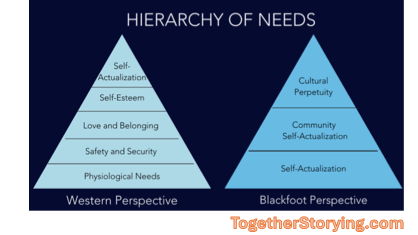
1. Maslow and the Blackfoot Inversion: Community Over Individual
In 1938, Maslow spent weeks with the Blackfoot (Siksika) Nation but filtered their worldview through Western individualism. He flipped their philosophy upside down: putting self-actualization at the top for the lone hero, shoving community to the base. The truth? Blackfoot thought centers community actualization, with individuals thriving only through contributions to collective wellbeing, deep ties to land, animals, seasons, and sustainability. Indigenous Canadian philosophies—Cree, Anishinaabe, and others—put relationality, reciprocity, and communal flourishing first.
2. North American Indigenous Roots Feeding Pragmatism
Scott Pratt's Native Pragmatism: Rethinking the Roots of American Philosophy maps an "Indigenous philosophical attitude" across Northeast nations like Haudenosaunee and Delaware: commitments to interaction, pluralism, community, and growth. These fed directly into American pragmatism via colonial encounters—treatymaking, federative governance, place-based reasoning—influencing Roger Williams, Benjamin Franklin, Emerson, then Peirce's inquiry, James's pluralism, and Dewey's democratic experimentalism.
3. Animistic Pragmatism: More-Than-Human Knowledge
Algonquian and Haudenosaunee ontologies treat nonhuman beings as animate participants in social worlds, anticipating pragmatist rejections of rigid subject-object splits. Knowledge emerges from lived interaction in a more-than-human community. Alaska Native "animistic pragmatism" among Iñupiat frames subsistence as experimental inquiry guided by elders' narrative ecosophy—paralleling Dewey while rooted in humility, interdependence, and cooperative problem-solving.
4. Key Indigenous Voices Reclaiming Philosophy
- Scott L. Pratt — Landmark argument that American philosophy is unintelligible without Indigenous influences
- Brian Burkhart (Cherokee) — Indigenous "place-thought" reframes pragmatist community and experience through land-based epistemologies
- Kyle Powys Whyte (Potawatomi) — Revises Deweyan inquiry and habit for Indigenous environmental justice and climate ethics
- Dale Turner (Temagami First Nation) — Engages pragmatism while insisting on Indigenous intellectual sovereignty
- Gregory Cajete (Santa Clara Pueblo) — Native pedagogies of experience and story exceed pragmatist accounts of learning
These aren't add-ons; they expose how standard histories erased Indigenous precursors.
5. Down Under: Provincializing "American" Pragmatism
Australian and New Zealand Indigenous authors aren't adopting pragmatism—they're provincializing it. Their land-based, relational, decolonial practices unsettle and prefigure Peirce, James, Dewey, and Rorty. "American" pragmatism looks like a late, partial offshoot of older Oceanic ways.
6. Reframing Experience and Land-Based Inquiry
Dewey's transactional engagement with a precarious world resonates with being-in-relationship to land, waters, kin—but Indigenous theorists add explicit responsibilities to place. Pragmatist inquiry (problem-driven, practical, situated) finds analogues in Indigenous validation: Does it sustain community, land, intergenerational reciprocity? Not just predictive control.
7. Linda Tuhiwai Smith: Decolonizing Methodologies
Linda Tuhiwai Smith (Ngāti Awa, Ngāti Porou) stands out in Decolonizing Methodologies. She exposes Western research—including pragmatist-flavored projects—as imperial. Kaupapa Māori research centers collective benefit, relational accountability, land. It flips Deweyan/Rortyan "inquiry" and "conversation": methods must ground in whakapapa, whenua, tino rangatiratanga.
8. Reworking the Canon with Indigenous Anchors
- Dewey's naturalism gets re-anchored in te ao Māori—language, marae relations, Treaty obligations
- James's pluralism extends to spiritual, ancestral, land-based agencies as real participants
- Rorty's solidarity? Indigenous critics show it can naturalize settler epistemic sovereignty; they reground it in Treaty relations, land claims, decolonial struggle—turning "conversation" into hui or wānanga with non-optional obligations to ancestors and future generations
9. Environmental Justice: Country as Agentic Kin
Australian Indigenous critiques of Deweyan schooling highlight anthropocentrism; they foreground Country as agentic kin. Environmental scholarship replaces extractive sustainability with Indigenous ontologies of kinship. This reverses genealogy: Peirce-James-Dewey-Rorty as "originators"? No—older Oceanic relational inquiry, communal verification, land-anchored ethics predate and exceed them.
10. Transgenerational Distributed Cognition: Elders as Living Supercomputers
Elders embody transgenerational distributed cognition: living "supercomputers" of collective memory, norms, knowledge, and adaptive strategies, passed through narrative moral testimony. This isn't abstract—it's pragmatic in the deepest sense: knowledge tested by how it sustains community and land.
11. Quantum Storytelling: Antenarrative Intervention
This braids into quantum storytelling work—antenarratives, before-bets-between, superposition of possibilities. Indigenous research as antenarrative intervention. Design labs: Superpose pragmatist concepts with Indigenous anchors; collapse toward sovereignty, land, community.
12. Living Praxis: Storying the World Otherwise
This isn't nostalgia—it's living praxis. Indigenous pragmatism, North and South, reclaims storytelling as experimental, relational, land-honoring ways to "go on together." In quantum view, it's about collapsing settler-Indigenous superpositions into futures that forecare for Mother Earth and all our relations.
7 American Pragmatist Principles (Version 3.0)
Version 3.0 explicitly acknowledges that American Pragmatism emerged from Indigenous intellectual traditions. These seven principles integrate Indigenous Ways of Knowing (IWOK) with pragmatist philosophy:
1. Experiential Learning (Indigenous Grounding)
Knowledge comes through direct experience and relationship with the living world, not abstract theorizing. This reflects Indigenous pedagogy of learning through doing and being in relationship with land and community.
2. Consequences Matter (Seven Generations Thinking)
Truth is measured by its practical effects - not just immediate outcomes, but impacts across seven generations. This Indigenous principle of long-term responsibility informs pragmatist focus on consequences.
3. Pluralism and Multiplicity (Relational Ontology)
Reality is multi-perspectival. Just as Indigenous ontologies recognize multiple ways of being and knowing, pragmatism embraces pluralistic truths that work in different contexts.
4. Inquiry in Community (Council Practices)
Truth emerges through collective inquiry, not individual speculation. This reflects Indigenous council traditions where wisdom arises through respectful dialogue and collective discernment.
5. Fallibilism and Openness (Humility Before Mystery)
No knowledge is final or absolute. Indigenous respect for mystery and the unknown informs pragmatist humility about the limits of human understanding.
6. Growth and Change (Cyclical Renewal)
Reality is processual, not static. Indigenous understanding of seasonal cycles and constant renewal underpins pragmatist emphasis on growth, development, and transformation.
7. Action-Oriented (Sacred Reciprocity)
Philosophy must guide action and practice. Like Indigenous emphasis on reciprocal relationship and responsibility, pragmatism insists on translating ideas into lived reality and right action.